Tag Archives: Exercise

The Impact Of The Microbiome On Lifespan

Germ-free mice (animals don’t have a microbiome) live longer than microbiome-containing mice, but it’s impractical for people to live in a bubble for their entire lifespan. As a more practical approach, which microbiome-derived factors impact lifespan, and can they be modified?

Dietary supplementation with acarbose increases lifespan, and one reason for that may involve reduced circulating levels of glucose, but the other side of that story involves increased gut bacterial production of short chain fatty acids (SCFAs). Whether acarbose will increase lifespan in people is unknown, and with the goal of increasing lifespan, are there other ways to increase SCFAs?

Resting Heart Rate, Heart Rate Variability: December 2019 Update

In earlier posts, I reported year-over-year improvements for my resting heart rate (RHR), from 51.5 (bpm) when I first started tracking in August 2018 to 48 bpm in November 2019 (https://michaellustgarten.wordpress.com/2019/12/05/resting-heart-rate-heart-rate-variability-still-making-progress/). Did my year-over-year RHR improvement continue in December 2019?

As shown below, in December 2018, my average RHR was 49.5 bpm. In December 2019, it was 47.5! These data are significantly different (p=6.5E-05):

rhr dec 2019

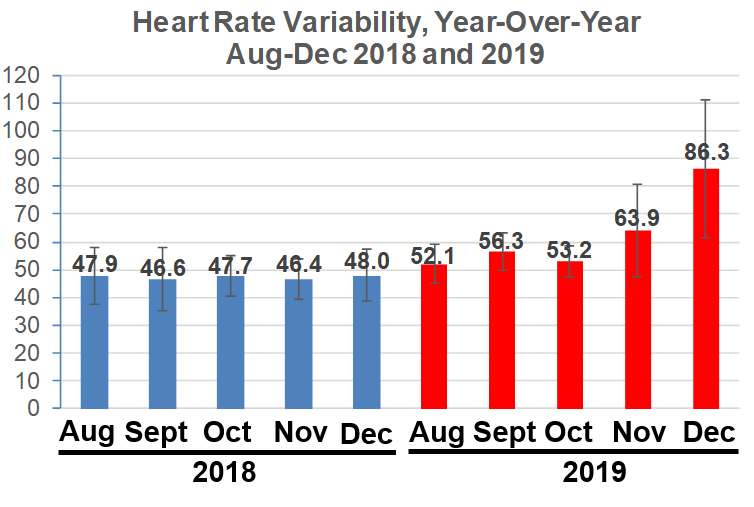
While RHR is one metric of cardiovascular health, heart rate variability (HRV) is another. With a stronger heart, the expectation would be a lower RHR, but a higher HRV. December 2019 was my best month ever for HRV, with an average HRV value of 86.3!

hrv 12 2019

Also note that December 2019’s HRV value is significantly different when compared with December 2018 (p=1.6E-11).

How am I able to continuously improve my RHR, and recently, my HRV? I average 15-20 miles of walking per week, and 3-4 days/week of structured exercise (1 hr/session), including a combination of weights, core, and stretching. My average HR during my structured workouts had been ~105 bpm prior to the past few months, but in November and December 2019 I made more of an effort to minimize rest periods, and included higher reps to keep my exercise HR as high as possible. My goal is to get my RHR to 40 bpm, which is associated with maximally reduced risk of death for all causes (https://michaellustgarten.wordpress.com/2019/02/02/resting-heart-rate-whats-optimal/). Stay tuned for more RHR and HRV data next month!

If you’re interested, please have a look at my book!

Epigenetic Aging: Inflammation, Exercise, Smoking

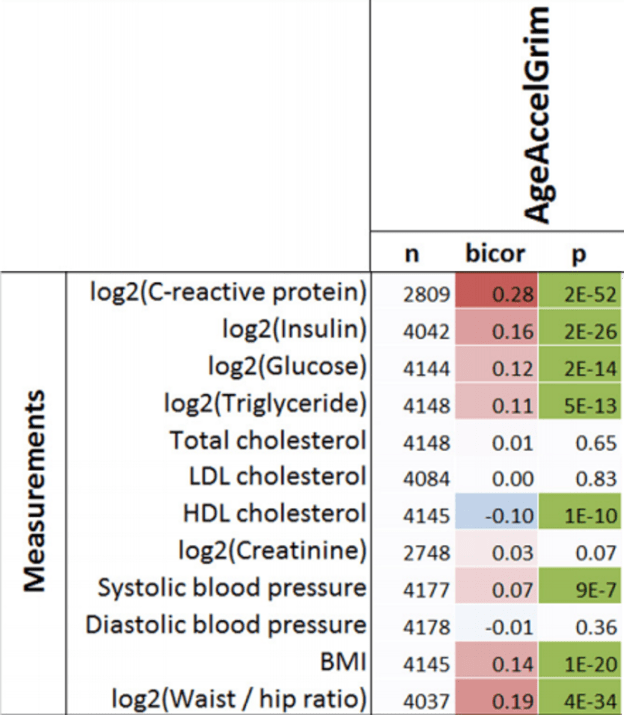
Besides diet (https://michaellustgarten.wordpress.com/2019/12/07/slowing-epigenetic-aging-with-diet/), are there other factors that may impact epigenetic aging? First, let’s have a look at clinically relevant variables, including inflammation, the lipid profile, kidney function, blood pressure, and body size/dimensions (Liu et al. 2019):

EA crp.png

One of the strongest correlations for the clinical variables with epigenetic aging (AgeAccelGrim) is found for C-reactive protein (CRP), with higher CRP being associated with an older epigenetic age. This data supports the hypothesis that CRP levels as low as possible may be representative of biological youth, which I’ve previously written about (https://michaellustgarten.wordpress.com/2019/10/19/optimizing-biological-age-crp/). Similarly, higher values for insulin, glucose, triglycerides, systolic blood pressure, BMI, and the waist/hip ratio were correlated with an older epigenetic age, whereas higher HDL was correlated with a younger epigenetic age. Significant correlations were not identified for total or LDL cholesterol, creatinine, or diastolic blood pressure.

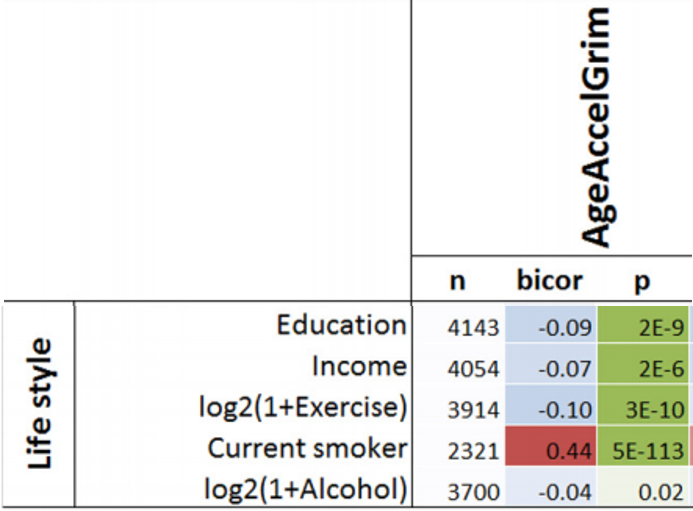
Investigating further, the strongest correlation for epigenetic aging was found for smoking, as current smokers had an older epigenetic age. In contrast, those who exercised, drank alcohol, and that had higher levels of education and income had younger epigenetic ages (Liu et al. 2019):

exerc ea


References

Lu AT, Quach A, Wilson JG, Reiner AP, Aviv A, Raj K, Hou L, Baccarelli AA, Li Y, Stewart JD, Whitsel EA, Assimes TL, Ferrucci L, Horvath S. DNA methylation GrimAge strongly predicts lifespan and healthspan. Aging (Albany NY). 2019 Jan 21;11(2):303-327. doi: 10.18632/aging.101684.

If you’re interested, please have a look at my book!

Resting heart rate: What’s optimal?

One of the goals of my exercise program is to reduce my resting heart rate (RHR). A stronger heart beats less times per minute, but pumps more blood per beat. In contrast, a weaker heart beats more times per minute, but less blood per beat.

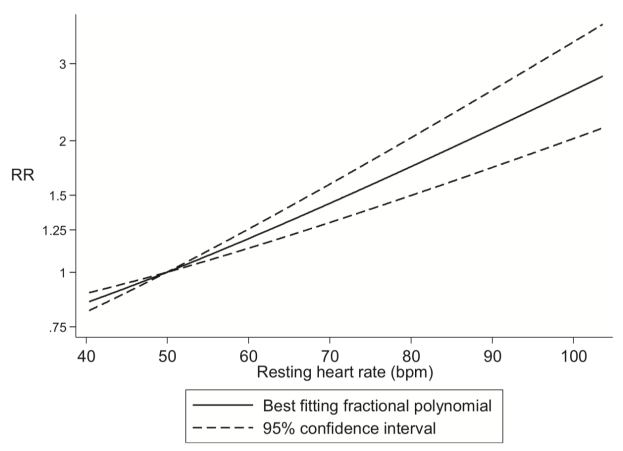
Is there an optimal level for RHR? Based on a meta-analysis of 59 studies that included 1,810,695 subjects, RHR values < 50 beats per minute (bpm) are associated with maximally reduced risk of death from all causes. Conversely, RHR values > 50 bpm are associated with a higher mortality risk (Aune et al. 2017):

Screen Shot 2019-02-02 at 10.48.29 AM

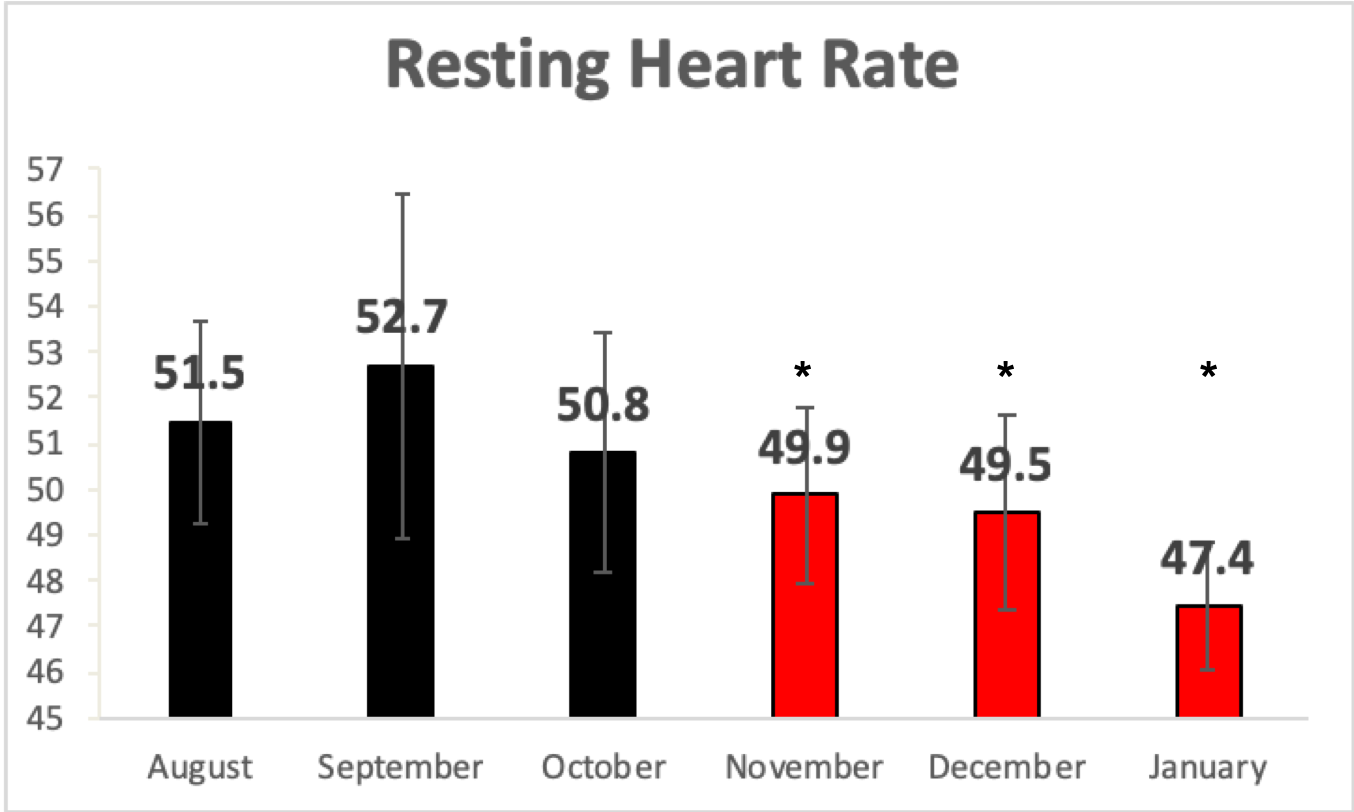
What’s my resting heart rate? Shown below is that data, tracked by WHOOP since August. Note that my RHR wasn’t significantly different from August until October, ranging from 51-53 bpm (average, 51.7). However, because I was tracking my RHR, I noticed that I was overtraining, leading to very high HRs, lower heart rate variability, and less deep sleep (topics for another post!) the day(s) after exercise. So early in November, I changed my exercise routine. As a result, from November until the end of January, my average RHR (49.7 bpm) has been significantly less (p-value =1E-10), and based on January’s average RHR, I’m trending closer to 47 bpm! Also note that * = significantly different when compared with August.
hr

What did I change in my exercise program? Since I’ve been in Boston (~9 years), I’ve walked 15-20 miles per week: it’s 1.1 miles to and from work, plus at least an hour of walking on Saturdays and Sundays. That’s a constant that hasn’t changed. In contrast, I split my 3-day weight training routine, which totaled ~5-6 hours/week into 3-5 days at less than an hour each session, and at a lower intensity with more reps. My strength is still as good as it was before, and as a result, my recovery HRs aren’t as high, thereby leading to a lower average RHR over time,. I’ve been training like that consistently for the past 30 years, but it took wearing a fitness tracker to change it!


Reference

Aune D, Sen A, ó’Hartaigh B, Janszky I, Romundstad PR, Tonstad S, Vatten LJ. Resting heart rate and the risk of cardiovascular diseasetotal cancer, and all-cause mortality – A systematic review and dose-response meta-analysis of prospective studiesNutr Metab Cardiovasc Dis. 2017 Jun;27(6):504-517.


If you’re interested in living longer and healthier, please have a look at my book!