Join us on Patreon! https://www.patreon.com/MichaelLustga…
Levine’s Biological age calculator is embedded as an Excel file in this link: https://atomic-temporary-71218033.wpcomstaging.com/2019/09…

Join us on Patreon! https://www.patreon.com/MichaelLustga…
Levine’s Biological age calculator is embedded as an Excel file in this link: https://atomic-temporary-71218033.wpcomstaging.com/2019/09…
Join us on Patreon! https://www.patreon.com/MichaelLustgartenPhD
Levine’s Biological age calculator is embedded as an Excel file in this link: https://michaellustgarten.wordpress.com/2019/09/09/quantifying-biological-age/
DNA methylation GrimAge strongly predicts lifespan and healthspan
https://pubmed.ncbi.nlm.nih.gov/30669119/
Fisetin is a senotherapeutic that extends health and lifespan https://www.ncbi.nlm.nih.gov/pmc/articles/PMC6197652/
Dietary intakes of flavonols, flavones and isoflavones by Japanese women and the inverse correlation between quercetin intake and plasma LDL cholesterol concentration
https://pubmed.ncbi.nlm.nih.gov/10958819/
NAD and the aging process: Role in life, death and everything in between https://pubmed.ncbi.nlm.nih.gov/27825999/


Here’s my latest video!
For more info on my data-to-day data for diet, fitness, sneak peaks for videos in production and more, join us on Patreon!
https://www.patreon.com/MichaelLustgartenPhD

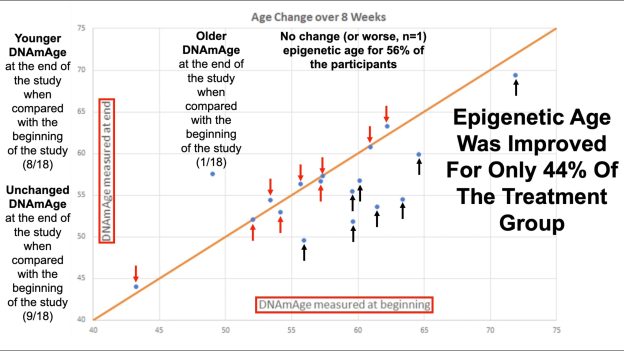
Paper references for Levine’s Phenotypic Age calculator and aging.ai:
An epigenetic biomarker of aging for lifespan and healthspan: https://pubmed.ncbi.nlm.nih.gov/29676…
Population Specific Biomarkers of Human Aging: A Big Data Study Using South Korean, Canadian, and Eastern European Patient Populations:
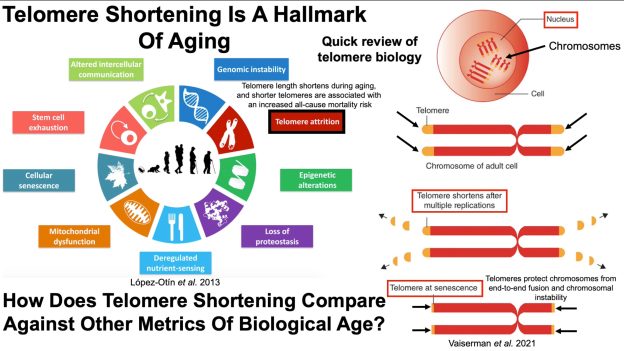
Papers referenced in the video:
The Hallmarks of Aging: https://www.ncbi.nlm.nih.gov/pmc/arti…
Telomere Length as a Marker of Biological Age: State-of-the-Art, Open Issues, and Future Perspectives: https://www.ncbi.nlm.nih.gov/pmc/arti…
Telomeres and the natural lifespan limit in humans: https://www.ncbi.nlm.nih.gov/pmc/arti…
Telomere Length and All-Cause Mortality: A Meta-analysis: https://pubmed.ncbi.nlm.nih.gov/30254…
Comparability of biological aging measures in the National Health and Nutrition Examination Study, 1999-2002: https://pubmed.ncbi.nlm.nih.gov/30999…
Longitudinal trajectories, correlations and mortality associations of nine biological ages across 20-years follow-up: https://elifesciences.org/articles/51507
Eleven Telomere, Epigenetic Clock, and Biomarker-Composite Quantifications of Biological Aging: Do They Measure the Same Thing? https://pubmed.ncbi.nlm.nih.gov/29149…
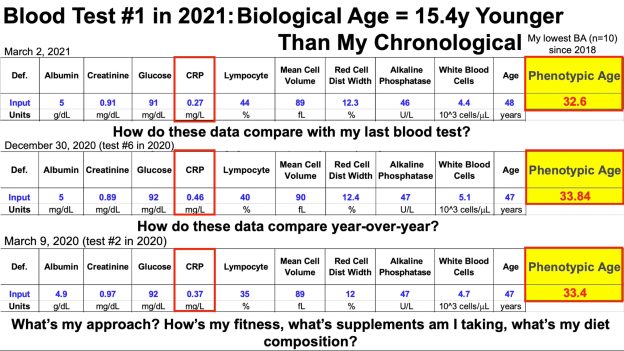
Results for my first blood test in 2021 are in-what’s my biological age, and how am I optimizing it?
If you’re interested in calculating your biological age, the spreadsheet is included as an Excel file in this link:

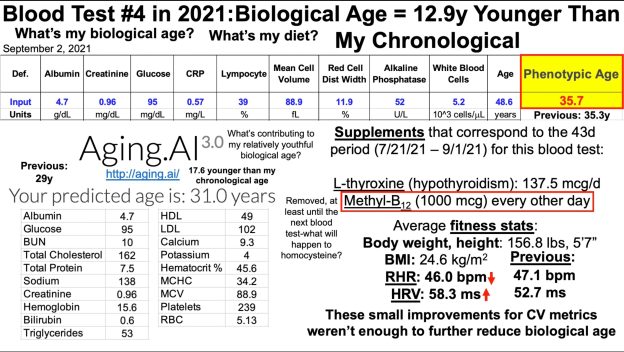
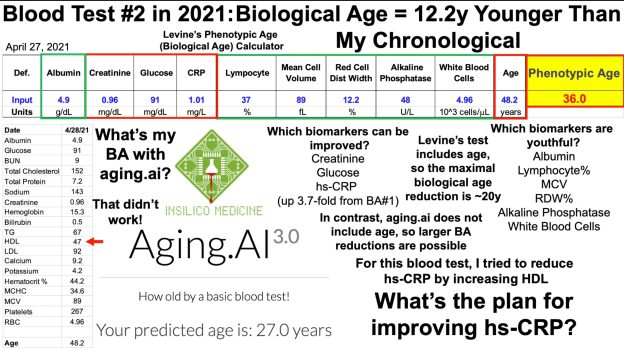
The maximal reduction for biological age when using the biological age calculator, Phenotypic Age, is ~20 years. In other words, if I’m 80 years old and my biomarkers are all reflective of youth, the lowest possible biological age will be ~60 years old. One reason for that is the inclusion of chronological age in the prediction of biological age, which adds strength to the correlation while simultaneously limiting the maximal biological age reduction.
To account for the possibility that youthful biomarkers at an older chronological age can yield a biological age that is more than 20 years younger, it’s important to quantify biological age using a tool that doesn’t include chronological age in its calculation. Aging.ai fits that criterion, and in the video I present biological age data with use of aging.ai for 24 blood tests since 2009.
 Michael Lustgarten