How does the gut microbiome and its metabolic products affect muscle mass, muscle composition, and physical function? In this presentation, I review the evidence, then I present recent data from our group.
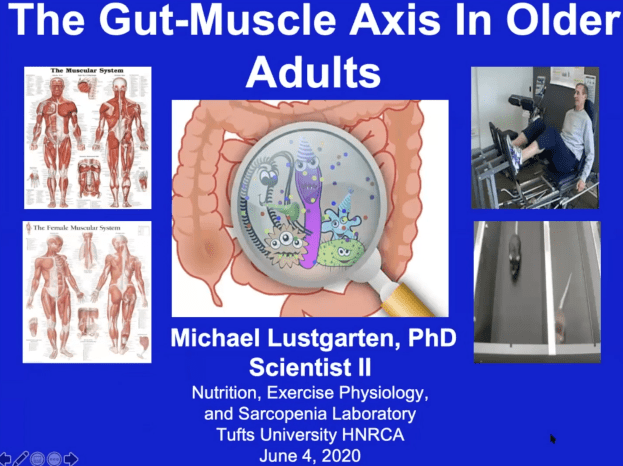
How does the gut microbiome and its metabolic products affect muscle mass, muscle composition, and physical function? In this presentation, I review the evidence, then I present recent data from our group.

Here’s a video clip about my latest Biological Age measurement!

Most often overlooked on a standard blood test are the mean corpuscular volume (MCW) and Red Blood Cell Distribution Width (RDW). How do they change during aging, and what’s associated with all-cause mortality risk? Also, with the goal of optimizing MCV and RDW, how does my diet correlate with these biomarkers?


Interestingly, we recorded this as I was recovering from a respiratory infection. Was it SARS-CoV-2, or influenza? I’ll know later this week!
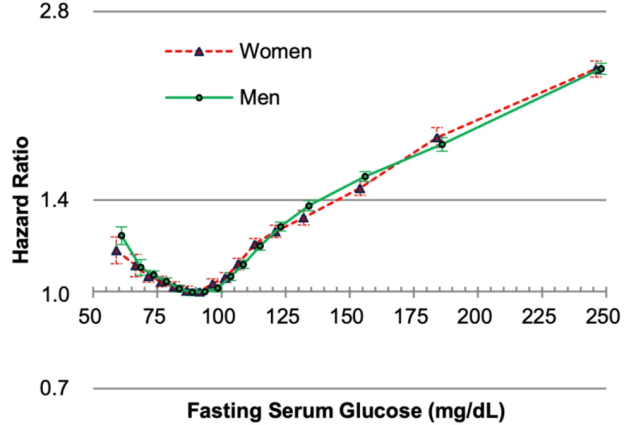

In the first 45 minutes, discuss each of the biomarkers contained within Levine’s Biological Age calculator, Phenotypic Age.
After that, I answer questions from the audience and we discuss all things related to aging.
There are a few ways that we can fight the novel coronavirus (SARS-CoV-2). Clinical trials aimed at vaccination have recently begun, and at the earliest, could be available within 6-18 months. Similarly, drugs aimed at inhibiting, blocking, or reducing viral replication, including remdesevir and hydoxychloroquine are entering clinical trials, but large-scale results are also a few months away.
Other alternatives that are rarely discussed are dietary components that can inhibit SARS-CoV-2 replication. Inhibiting replication is important because if the virus continually makes more copies of itself, there will be a systemic viral overload, thereby overwhelming the immune system. Two coronavirus proteins that are important for its replication and binding to cell membranes are its Main protease (Mpro for SARS-CoV-2, 3CLpro for SARS-CoV; X. Liu & Wang, 2020), and its surface Spike glycoprotein (S protein; Song et al. 2018), respectively.
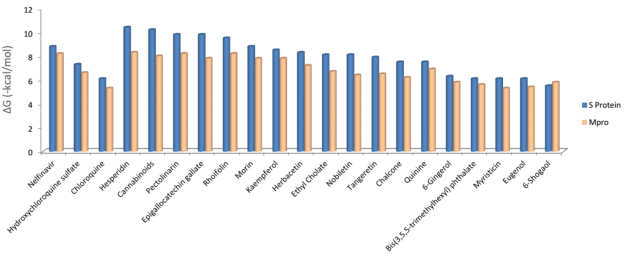
In a recently published (but not peer-reviewed) preprint, Tallei et al. (2020) used a molecular docking approach to predict how SARS-CoV-2’s Mpro and S proteins interact with various drugs and plant-based compounds. A lower molecular docking value is indicative of a potentially better ability to inhibit these proteins. Interestingly, many plant-based metabolites have lower (or equal) molecular docking values when compared with coronavirus-based drugs:
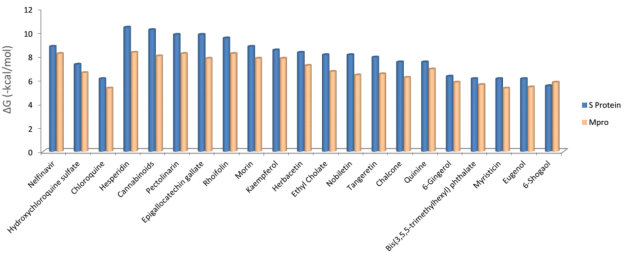
For example, when compared with the drugs nelfinavir, hyrdroxychloroquine sulfate, and chloroquine, hesperidin (found in citrus fruits and peppermint) and epigallocatechin galleate (found in green tea, apple skin, plums, onions, hazelnut) had equivalent or lower molecular docking scores, evidence that suggests a better ability for the plant-based metabolites to inhibit Mpro and the S protein. Based on this data, incorporation of these foods may be an important strategy for boosting endogenous defense against SARS-CoV-2 infection.
Similarly, a molecular docking approach was used to identify potential inhibitors for Mpro in another recent preprint (Khaerunnisa et al. 2020). When compared with the docking energy for Mpro’s native ligand (-8), the coronavirus drugs nelfinavir and lopinavir had lower docking energies, thereby suggesting that they would be good Mpro inhibitors. Interestingly, kaempferol and quercetin had docking energies that were not as low as the drugs, but were as low as or lower than the docking energy for Mpro’s native ligand, thereby suggesting that they might also act as inhibitors of SARS-CoV-2 replication:
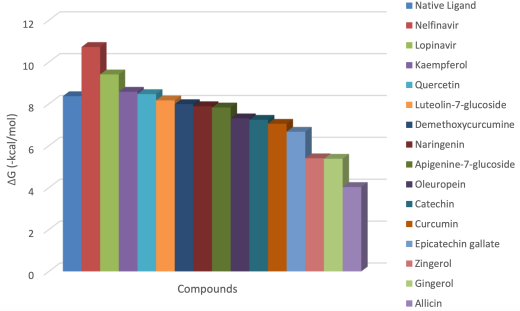
Kaempferol and quercetin are found in relatively high amounts in dill, lettuce, onions, spinach and other vegetables (for the full list see https://www.ars.usda.gov/ARSUserFiles/80400525/Data/Flav/Flav_R03.pdf).
It’s important to note that the amount of these foods needed to ingest enough kaempferol, quercetin, or other metabolites that may inhibit SARS-CoV-2 replication or its fusion to cell membranes proteins in vivo is unknown. In addition, with the goal of further boosting endogenous defense, I’d propose including these foods in addition to, but not for the replacement of a vaccine or FDA approved medicines. Note that clinical trials aimed at direct testing for the ability of these plant-based components to inhibit SARS-CoV-2 replication has yet to be performed, but when consumed as a part of a whole-food diet, may be a low risk, high reward strategy for battling SARS-CoV-2 infection.
References
Khaerunnisa, S., Kurniawan, H., Awaluddin R., Suhartati S., Soetjipto, S. (2020). Potential Inhibitor of COVID-19 Main Protease (Mpro) from Several Medicinal Plant Compounds by Molecular Docking Study. March 13, Preprint. doi: 10.20944/preprints202003.0226.v1
Liu, X., & Wang, X.-J. (2020). Potential inhibitors for 2019-nCoV coronavirus M protease from clinically approved medicines. BioRxiv, 2020.01.29.924100. https://doi.org/10.1101/2020.01.29.924100.
Song, W., Gui, M., Wang, X., & Xiang, Y. (2018). Cryo-EM structure of the SARS coronavirus spike glycoprotein in complex with its host cell receptor ACE2. PLOS Pathogens, 14(8), e1007236. https://doi.org/10.1371/journal.ppat.1007236.
Tallei, T.E., Tumilaar, S.G., Niode, N.J. , Fatimawali, Kepel4, B.J., Idroes, R., Effendi Y. (2020). Potential of Plant Bioactive Compounds as SARS-CoV-2 Main Protease (Mpro) and Spike (S) Glycoprotein Inhibitors: A Molecular Docking Study. April 9, Preprint. doi: 10.20944/preprints202004.0102.v2.
Coronavirus isn’t the only virus that negatively affects human health. For more info,
https://www.amazon.com/dp/B01G48A88A
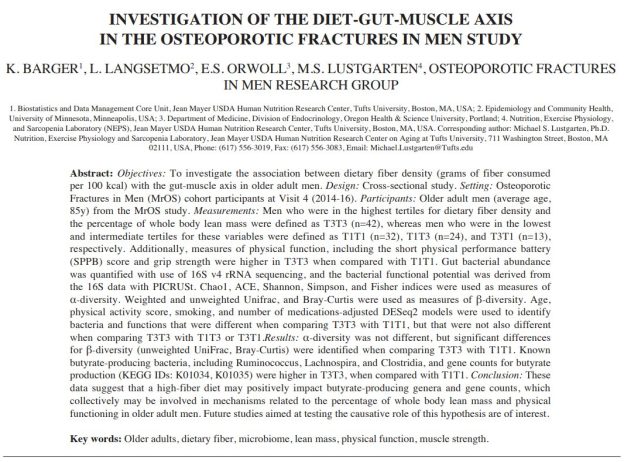

Exactly 1 month ago, my first biological age measurement of 2020 was 32.75y (https://michaellustgarten.wordpress.com/2020/02/14/biological-age-32-75y-chronological-age-47y-first-2020-measurement/). When considering that my chronological age is 47y, that’s a 14 year improvement, but I wasn’t (and still aren’t) satisfied. When I sent my blood for analysis, I was battling a mild upper respiratory infection (cough, no fever), which likely raised my WBCs, thereby resulting in a higher biologic age. Also, I was experimenting with a higher intake of meat, eggs, and cheese, to see what affect that it would have on my circulating biomarkers. On that blood test in February, my creatinine levels were higher than my 2015-2020 average value, and if those foods were associated with circulating levels of creatinine, reducing them should also reduce creatinine, and accordingly, further improve my biological age. I also assumed that all other variables on Levine’s Phenotypic Age calculator would be unchanged.
On March 9 2020, I sent my blood for analysis so that I could calculate biological age with Levine’s PhenotypicAge. Almost exactly as expected, my WBCs (4.7 * 10^3 cells/microliter) were closer to my 2015-2020 average value (4.6), rather than the higher value (5.8) in my blood test last month. Similarly, reducing my intake of beef, eggs, and cheese brought creatinine from 1.08 to 0.97 mg/dL, which is closer to its 5-year average (0.94 mg/dL). As a result, I further reduced my biological age by 1.14 years to 31.61y, which is 15+ years younger than my chronological!

Because I track my diet every day, I can investigate the correlation between my meat, eggs, and cheese intake with creatinine. I now have 8 blood tests that correspond to dietary data, and interestingly, there is a moderately strong correlation between my average daily beef+egg+cheese intake with creatinine (r = 0.55). Based on these data, I’m going to continue to minimize consumption of these foods, with the goal of optimizing creatinine.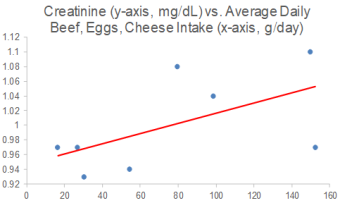
On a final note, I also expected to further reduce my CRP from 0.3 to something lower, but it slightly increased to 0.37 mg/L. While that is far from a high value, lower is better, and in future blood tests I’ll try to figure out how to further reduce it.
If you’re interested in calculating your biological age, here’s the Excel link:
 Michael Lustgarten