Here’s my latest video!
For more info on my data-to-day data for diet, fitness, sneak peaks for videos in production and more, join us on Patreon!
https://www.patreon.com/MichaelLustgartenPhD
Here’s my latest video!
For more info on my data-to-day data for diet, fitness, sneak peaks for videos in production and more, join us on Patreon!
https://www.patreon.com/MichaelLustgartenPhD
Papers referenced in the video:
Therapeutic Potential of NAD-Boosting Molecules: The In Vivo Evidence: https://pubmed.ncbi.nlm.nih.gov/29514…
NAD and the aging process: Role in life, death and everything in between: https://pubmed.ncbi.nlm.nih.gov/27825…
Flavonoids as inhibitors of human CD38: https://pubmed.ncbi.nlm.nih.gov/21641…
Flavonoid apigenin is an inhibitor of the NAD+ ase CD38: implications for cellular NAD+ metabolism, protein acetylation, and treatment of metabolic syndrome: https://pubmed.ncbi.nlm.nih.gov/23172…
Characterization of Anthocyanins and Proanthocyanidins in Some Cultivars of Ribes, Aronia, and Sambucus and Their Antioxidant Capacity: https://pubmed.ncbi.nlm.nih.gov/15612…
Flavonoid glycosides and antioxidant capacity of various blackberry, blueberry and red grape genotypes determined by high-performance liquid chromatography/mass spectrometry: https://onlinelibrary.wiley.com/doi/1…
USDA Database for the Flavonoid Content of Selected Foods: https://www.ars.usda.gov/arsuserfiles… Large changes in NAD levels associated with CD38 expression during HL-60 cell differentiation: https://pubmed.ncbi.nlm.nih.gov/24216…
Effect of genotype and environment on flavonoid concentration and profile of black sorghum grains (incorrectly indicated as Dykes et al. 2013): https://www.sciencedirect.com/science…
Luteolinidin Protects the Post-ischemic Heart through CD38 Inhibition with Preservation of NAD(P)(H): https://jpet.aspetjournals.org/conten…SHOW LESS
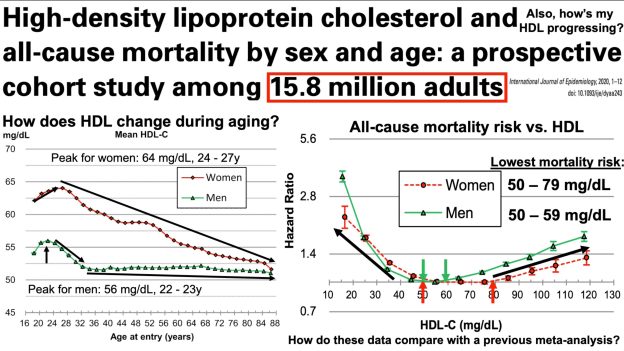
In November 2020, I made a HDL video based on a meta-analysis in ~3.4 million subjects that was published in July 2020. In Dec 2020, a larger study (n=15.8 million subjects) was published-those data are presented in the video, and compared against the meta-analysis.
In addition, I’ve tested my HDL 2 more times since November 2020, so how’s my progress for getting it into the optimal range? Also, I attempt to derive clinical significance by identifying correlations for higher HDL with lower Lp(a) and hs-CRP.
Video link: https://www.youtube.com/watch?v=MUuKlpyvZaU
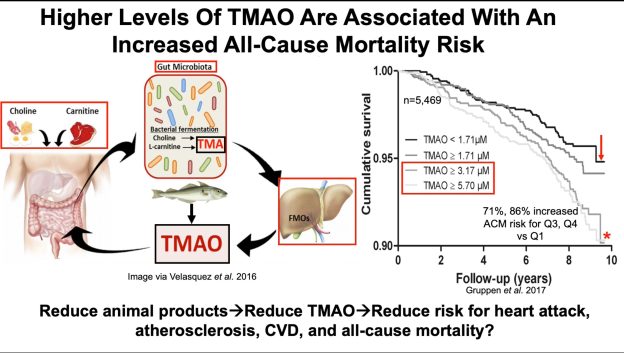
Animal products, including meat, cheese, and eggs contain carnitine and choline, metabolites that are converted by gut bacteria into TMA, which is then converted by the liver into TMAO. Plasma levels of TMAO are associated with an increased risk of disease and death, so should we limit intake of these animal products? Separately, fish contains relatively high levels of TMAO, and blood levels of TMAO spike after fish consumption, but there is a decreased all-cause mortality risk for fish consumers. To explain these disparate findings, other factors may be involved in the TMAO-health and disease story. In the video, I discuss the impact of kidney function on plasma levels of TMAO, disease and mortality risk.
My latest blood test results are in-how’s my biological age?
In the video I discuss my dietary approach prior to my latest blood test, the blood test results, and my plan to improve them with diet going forward.
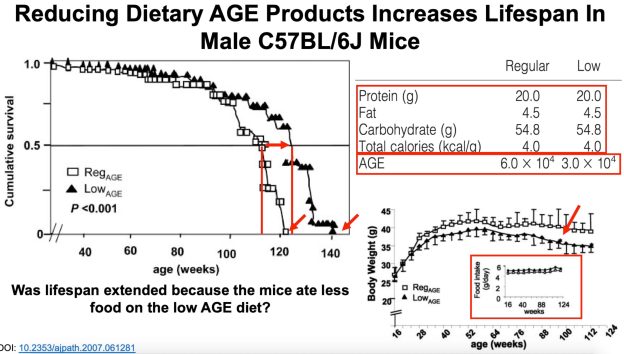
Cooking foods at temperatures higher than boiling produces advanced glycation end (AGE) products, which induce insulin resistance and inflammation, and shorten lifespan in mice. Similar data exists in humans for the effect of dietary AGE products on insulin resistance and inflammation, and a higher dietary AGE product intake is associated with cancer in both men and women. Accordingly, reducing dietary AGE product intake may be an important strategy for improving health and increasing lifespan in people.
Many interventions have been reported to increase NAD levels, but dietary components that can impact NAD levels are less discussed. Here, I highlight the ability of two dietary components, apigenin and quercetin to increase NAD, and report the foods that contain these metabolites.
There are a few ways that we can fight the novel coronavirus (SARS-CoV-2). Clinical trials aimed at vaccination have recently begun, and at the earliest, could be available within 6-18 months. Similarly, drugs aimed at inhibiting, blocking, or reducing viral replication, including remdesevir and hydoxychloroquine are entering clinical trials, but large-scale results are also a few months away.
Other alternatives that are rarely discussed are dietary components that can inhibit SARS-CoV-2 replication. Inhibiting replication is important because if the virus continually makes more copies of itself, there will be a systemic viral overload, thereby overwhelming the immune system. Two coronavirus proteins that are important for its replication and binding to cell membranes are its Main protease (Mpro for SARS-CoV-2, 3CLpro for SARS-CoV; X. Liu & Wang, 2020), and its surface Spike glycoprotein (S protein; Song et al. 2018), respectively.
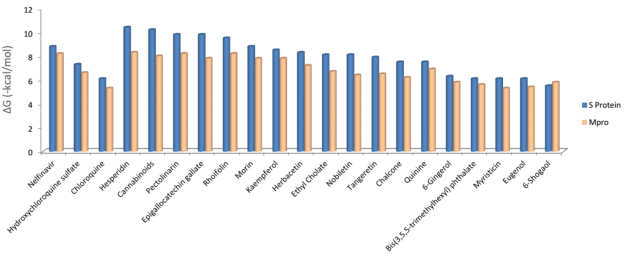
In a recently published (but not peer-reviewed) preprint, Tallei et al. (2020) used a molecular docking approach to predict how SARS-CoV-2’s Mpro and S proteins interact with various drugs and plant-based compounds. A lower molecular docking value is indicative of a potentially better ability to inhibit these proteins. Interestingly, many plant-based metabolites have lower (or equal) molecular docking values when compared with coronavirus-based drugs:
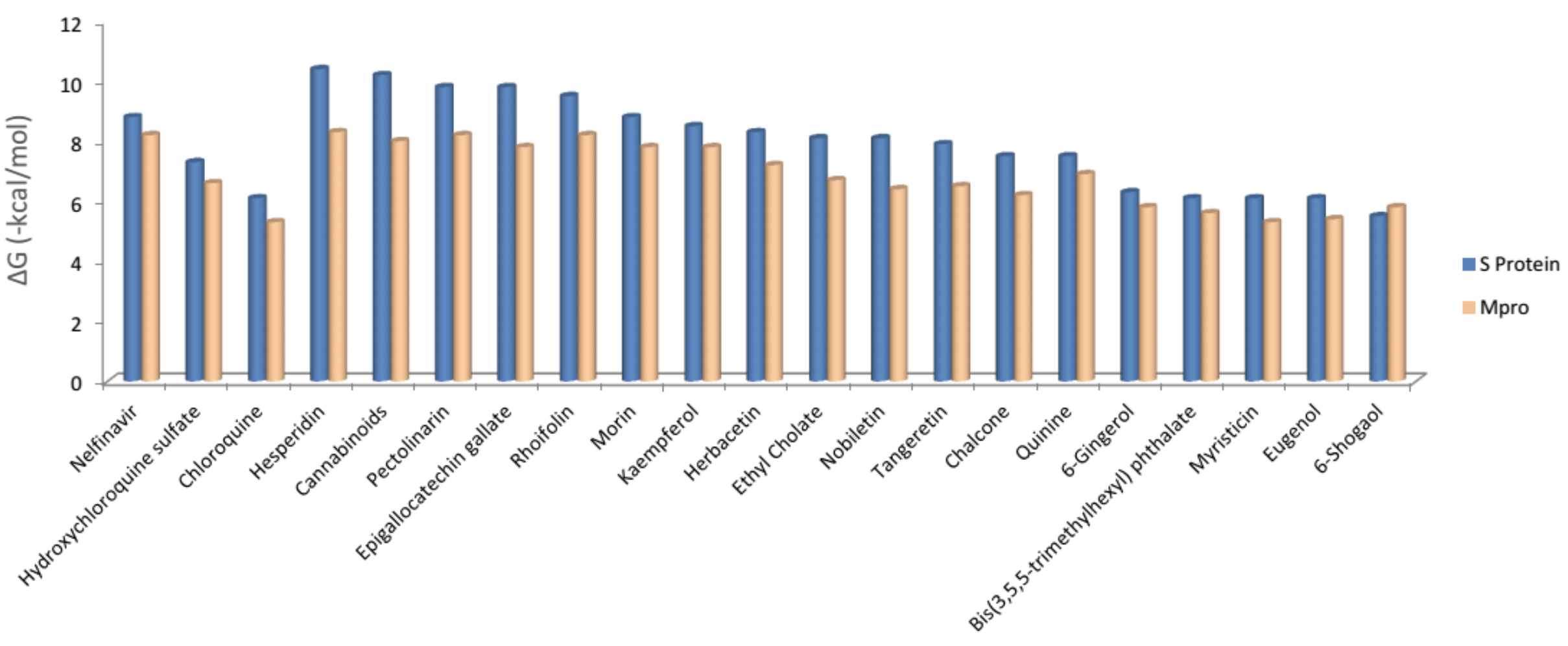
For example, when compared with the drugs nelfinavir, hyrdroxychloroquine sulfate, and chloroquine, hesperidin (found in citrus fruits and peppermint) and epigallocatechin galleate (found in green tea, apple skin, plums, onions, hazelnut) had equivalent or lower molecular docking scores, evidence that suggests a better ability for the plant-based metabolites to inhibit Mpro and the S protein. Based on this data, incorporation of these foods may be an important strategy for boosting endogenous defense against SARS-CoV-2 infection.
Similarly, a molecular docking approach was used to identify potential inhibitors for Mpro in another recent preprint (Khaerunnisa et al. 2020). When compared with the docking energy for Mpro’s native ligand (-8), the coronavirus drugs nelfinavir and lopinavir had lower docking energies, thereby suggesting that they would be good Mpro inhibitors. Interestingly, kaempferol and quercetin had docking energies that were not as low as the drugs, but were as low as or lower than the docking energy for Mpro’s native ligand, thereby suggesting that they might also act as inhibitors of SARS-CoV-2 replication:
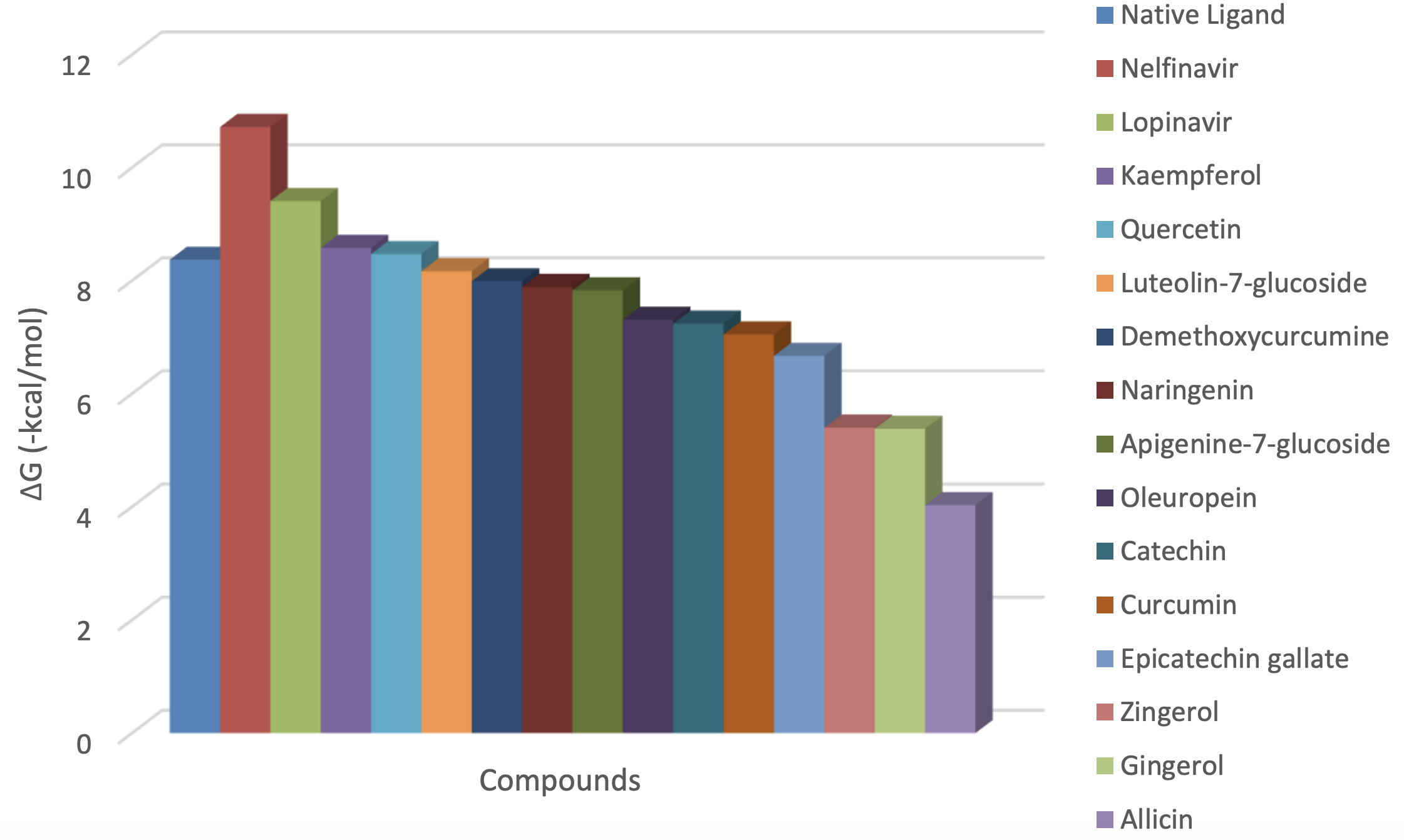
Kaempferol and quercetin are found in relatively high amounts in dill, lettuce, onions, spinach and other vegetables (for the full list see https://www.ars.usda.gov/ARSUserFiles/80400525/Data/Flav/Flav_R03.pdf).
It’s important to note that the amount of these foods needed to ingest enough kaempferol, quercetin, or other metabolites that may inhibit SARS-CoV-2 replication or its fusion to cell membranes proteins in vivo is unknown. In addition, with the goal of further boosting endogenous defense, I’d propose including these foods in addition to, but not for the replacement of a vaccine or FDA approved medicines. Note that clinical trials aimed at direct testing for the ability of these plant-based components to inhibit SARS-CoV-2 replication has yet to be performed, but when consumed as a part of a whole-food diet, may be a low risk, high reward strategy for battling SARS-CoV-2 infection.
References
Khaerunnisa, S., Kurniawan, H., Awaluddin R., Suhartati S., Soetjipto, S. (2020). Potential Inhibitor of COVID-19 Main Protease (Mpro) from Several Medicinal Plant Compounds by Molecular Docking Study. March 13, Preprint. doi: 10.20944/preprints202003.0226.v1
Liu, X., & Wang, X.-J. (2020). Potential inhibitors for 2019-nCoV coronavirus M protease from clinically approved medicines. BioRxiv, 2020.01.29.924100. https://doi.org/10.1101/2020.01.29.924100.
Song, W., Gui, M., Wang, X., & Xiang, Y. (2018). Cryo-EM structure of the SARS coronavirus spike glycoprotein in complex with its host cell receptor ACE2. PLOS Pathogens, 14(8), e1007236. https://doi.org/10.1371/journal.ppat.1007236.
Tallei, T.E., Tumilaar, S.G., Niode, N.J. , Fatimawali, Kepel4, B.J., Idroes, R., Effendi Y. (2020). Potential of Plant Bioactive Compounds as SARS-CoV-2 Main Protease (Mpro) and Spike (S) Glycoprotein Inhibitors: A Molecular Docking Study. April 9, Preprint. doi: 10.20944/preprints202004.0102.v2.
Coronavirus isn’t the only virus that negatively affects human health. For more info,
https://www.amazon.com/dp/B01G48A88A
My average biological age in 2019 is 12 years younger than my chronological age (46y) based on the Phenotypic Age calculator (https://michaellustgarten.wordpress.com/2019/11/01/biological-age-31-3y-chronological-age-46y/), and 16y younger based on aging.ai (https://michaellustgarten.wordpress.com/2019/11/04/years-of-biological-aging-in-the-past-4-years/). One factor that likely contributes to my relatively youthful biological age is my diet.
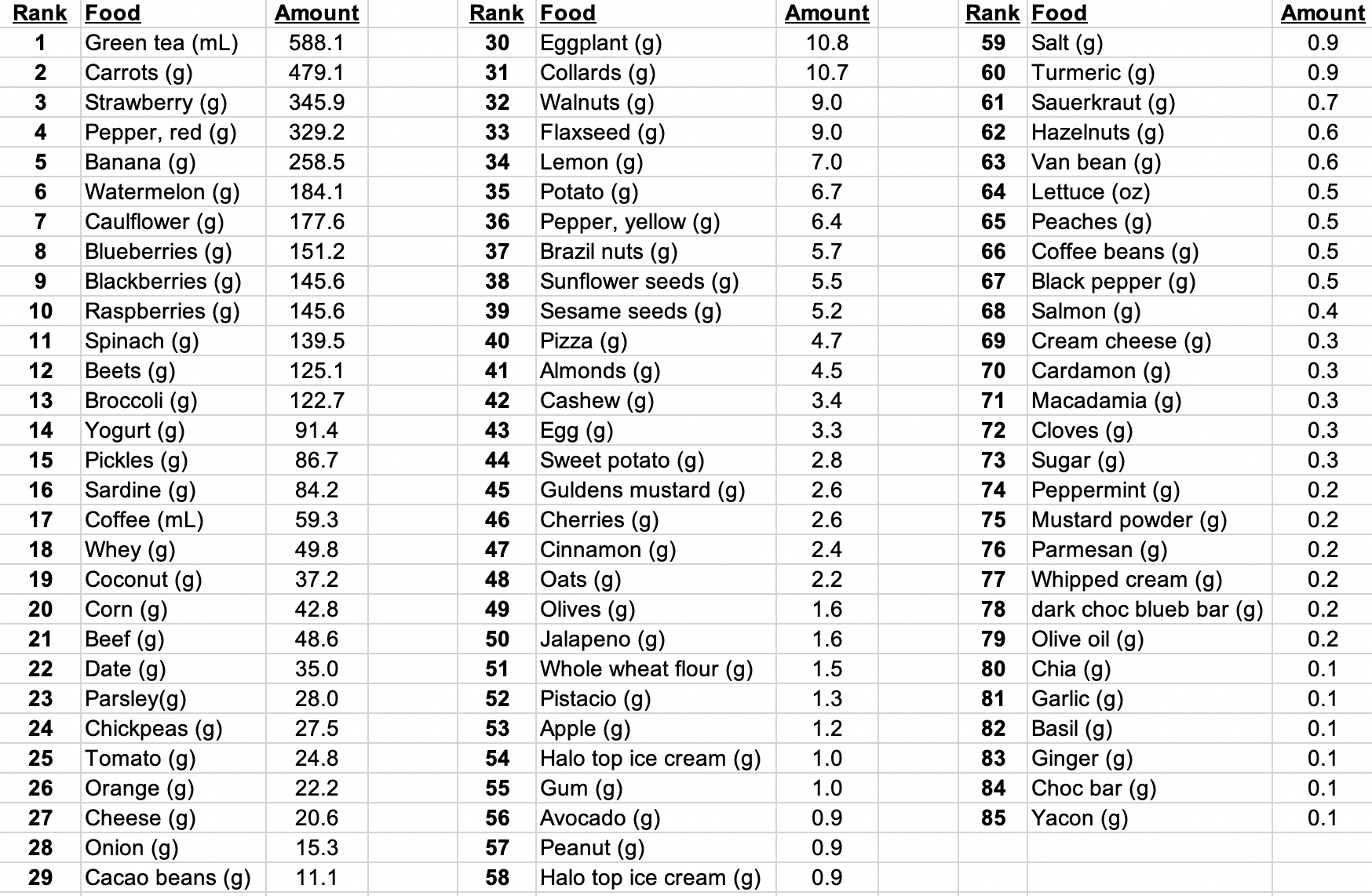
Shown below is my average daily dietary intake from January 1 through November 7th, 2019 (n=306 days). I weigh all of my food with a food scale, so these aren’t estimated amounts:

In terms of weight (or volume), green tea is atop the list, as I drink 20 oz/day. Carrots come in second place (for why, see https://michaellustgarten.wordpress.com/2018/07/06/serum-albumin-and-acm/), followed by strawberries, red bell peppers, bananas, watermelon (for the lycopene), cauliflower, blueberries, blackberries, and raspberries. Note that I mix the bananas and berries in my green smoothies, which I drink 3-4x/week, which includes spinach (#11) and parsley (#23).
What does my average daily macro- and micro-nutrient data look like for 2019?

Note that I purposefully have higher than the RDA values for several nutrients, including Vitamin C (see https://michaellustgarten.wordpress.com/2019/09/19/vitamin-c-dietary-intake-and-plasma-values-whats-optimal-for-health/), Vitamin K (see https://michaellustgarten.wordpress.com/2015/05/08/eat-more-green-leafy-vegetables-reduce-mortality-risk/), selenium (see https://michaellustgarten.wordpress.com/2015/05/28/selenium-dietary-intake-and-plasma-values-whats-optimal-for-health/), and others (see michaellustgarten.com).
In terms of supplements, I use 1000 IU of vitamin D from November – May, and I take a methylfolate-methylB12-B6 supplement, to help keep my homocysteine levels low.
If you’re interested, please have a look at my book!