LDL is arguably the most debated biomarker in terms of what’s optimal for health. In the video, I present data showing that 100 – 140, not 50 – 70 mg/dL may be optimal in terms of minimizing disease risk and maximizing longevity.
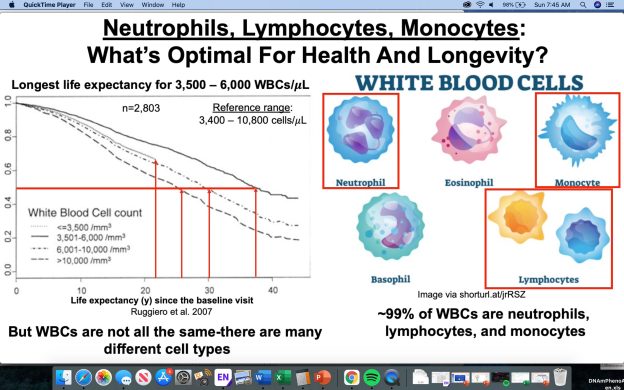
White blood cells (WBCs) comprise many different cell types, including neutrophils, lymphocytes, monocytes, eosinophils, and basophils.
Neutrophils, lymphocytes, and monocytes account for ~99% of WBCs, and accordingly, in the video I propose optimal ranges for these cell types in terms of health and longevity.
Here’s an interview that I did with Richard at Modern Healthspan, one of the best interviewers in aging!
Part I: Monitoring Biomarkers to Reverse Aging:
Part II, Diet, CR & Fasting:
Part III: Exercise, Protein
Part IV: Optimize Nutrients Through Diet
Part V: Inhibit CD38 to Optimize NAD
Part VI: Microbiome Impact on Muscle Metabolism
Part VII: Preferred Diet & Habit for Longevity
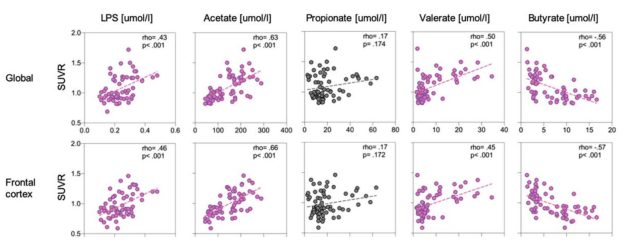
In the video below, Steve Hill from Lifespan.io and I talk about findings from a recent paper (https://content.iospress.com/articles/journal-of-alzheimers-disease/jad200306) that supports a role for the gut microbiome on Alxheimer’s disease. Check it out!
Meta-analysis for the association between HDL with all-cause mortality risk has identified HDL levels 55 – 60 mg/dL range as optimal. However, that data includes subjects up to 85y-in the video, I present data for 85y – 115yr olds that additionally suggests HDL in the 55 – 60 mg/dL range as optimal. In addition, I show my own HDL data over the past 15 years (n=34), the correlation for HDL with my diet, and how I plan on consistently increasing my 15-year average HDL of ~44 mg/dL to the 50’s.
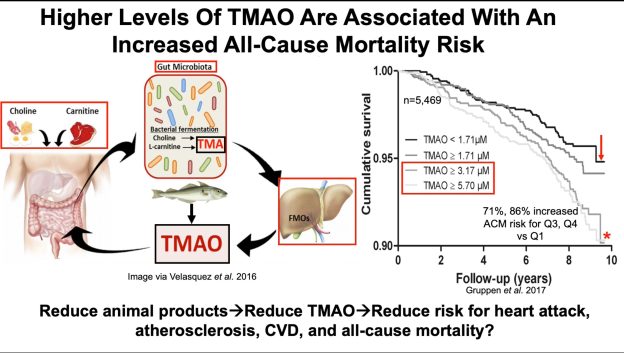
Animal products, including meat, cheese, and eggs contain carnitine and choline, metabolites that are converted by gut bacteria into TMA, which is then converted by the liver into TMAO. Plasma levels of TMAO are associated with an increased risk of disease and death, so should we limit intake of these animal products? Separately, fish contains relatively high levels of TMAO, and blood levels of TMAO spike after fish consumption, but there is a decreased all-cause mortality risk for fish consumers. To explain these disparate findings, other factors may be involved in the TMAO-health and disease story. In the video, I discuss the impact of kidney function on plasma levels of TMAO, disease and mortality risk.
A reduced mortality risk and an increased lifespan has been reported for people who have APOE2 alleles, when compared with APOE3 or APOE4, but beyond associations, data for lifespan in APOE-expressing mice was recently reported, evidence that supports a causative role for APOE on longevity.
My latest blood test results are in-how’s my biological age?
In the video I discuss my dietary approach prior to my latest blood test, the blood test results, and my plan to improve them with diet going forward.
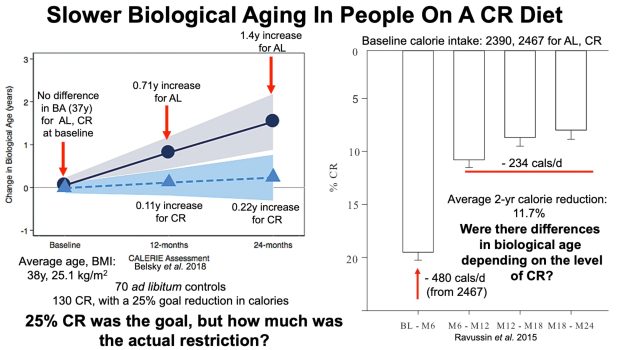
Calorie restriction (CR) is well known to extend average and maximal lifespan in a variety of animal models, but what about in people? In this video, I present evidence showing that CR slows biological aging, which suggests that CR will positively affect lifespan in people.
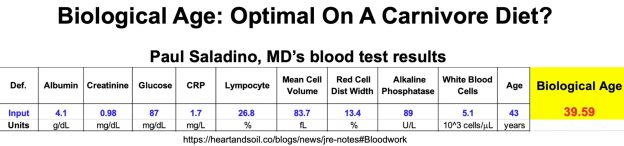
After going on Joe Rogan’s podcast, Paul Saladino, MD, posted his show notes, which included his blood test results. Based on that data, is his biological age optimal while on a carnivore diet?