Tag Archives: aging

Apigenin Increases Muscle Mass And Improves Muscle Function In Both Young And Old Mice

In an earlier video, I presented data for apigenin’s ability to increase levels of NAD+. In addition to apigenin’s impact on NAD+, apigenin supplementation increases muscle mass, strength, and treadmill running distance in both young and old mice.

Video link for NAD+ is increased in response to apigenin: https://youtu.be/5-2YoGctcCk?list=UUT…

Paper links:

Apigenin enhances skeletal muscle hypertrophy and myoblast differentiation by regulating Prmt7: https://pubmed.ncbi.nlm.nih.gov/29108…

Apigenin Ameliorates the Obesity‐Induced Skeletal Muscle Atrophy by Attenuating Mitochondrial Dysfunction in the Muscle of Obese Mice: https://onlinelibrary.wiley.com/doi/a…

Antioxidant Apigenin Relieves Age-Related Muscle Atrophy by Inhibiting Oxidative Stress and Hyperactive Mitophagy and Apoptosis in Skeletal Muscle of Mice: https://pubmed.ncbi.nlm.nih.gov/32857…

The Gut Microbiota Affects Health and Aging (Interview with Modern Healthspan): Parts I-VIII

Here’s the first interview clip (of a series) with Modern Healthspan on YouTube where we discuss the role of the microbiome on health and longevity:

Part II: Skin, Oral Microbiome & Immune System

Part III: Optimal Health with Soluble Fiber

Part IV – Microbial Burden & Hallmarks of Aging

Part V: Spermidine & Immune Support

Part VI: Optimal HDL & LDL

Part VII: Nuts, Seeds & Saturated Fat Intake

Part VII: My Exercise Approach for Longevity

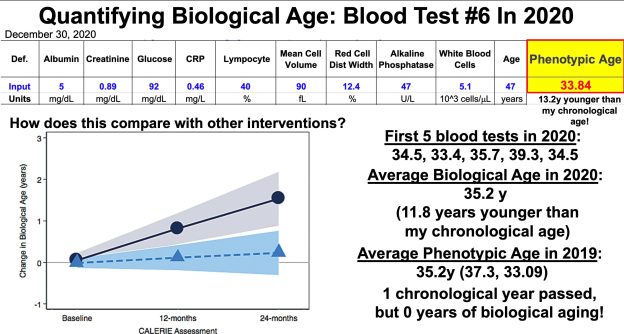
Blood Test #6 In 2020: What’s My Biological Age?

Discussed in the video:

What’s my biological age on blood test #6 in 2020?

What’s my average biological age for 2020, and how does it compare with 2019?

Are there links between calorie intake, cardiovascular fitness (RHR, HRV), and diet composition with my biological age?

Microbial Products Affect the Hallmarks Of Aging: 1) Mitochondrial Function

The Hallmarks of Aging are well established, but what is less discussed is the impact of microbes and/or microbial products. The bacterial metabolite, LPS, increases during aging, and it negatively impacts mitochondrial function, thereby demonstrating a role for microbial products on one of the Hallmarks of Aging, mitochondrial dysfunction.

LDL Cholesterol: What’s Optimal For Health And Longevity?

LDL is arguably the most debated biomarker in terms of what’s optimal for health. In the video, I present data showing that 100 – 140, not 50 – 70 mg/dL may be optimal in terms of minimizing disease risk and maximizing longevity.

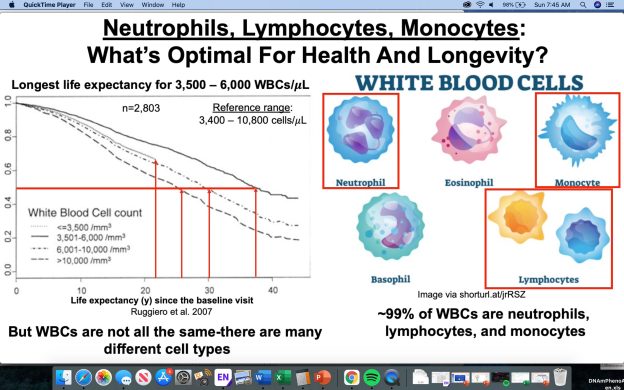
Neutrophils, Lymphocytes, Monocytes: What’s Optimal For Health And Longevity?

White blood cells (WBCs) comprise many different cell types, including neutrophils, lymphocytes, monocytes, eosinophils, and basophils.

Neutrophils, lymphocytes, and monocytes account for ~99% of WBCs, and accordingly, in the video I propose optimal ranges for these cell types in terms of health and longevity.

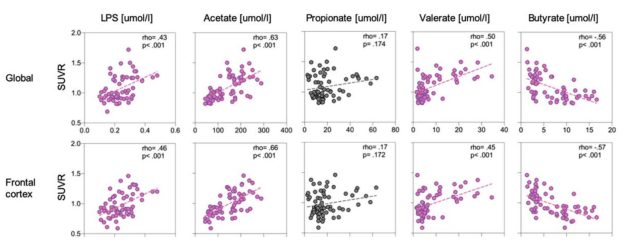
Paper Discussion: Short-Chain Fatty Acids and Lipopolysaccharide as Mediators Between Gut Dysbiosis and Amyloid Pathology in Alzheimer’s Disease

In the video below, Steve Hill from Lifespan.io and I talk about findings from a recent paper (https://content.iospress.com/articles/journal-of-alzheimers-disease/jad200306) that supports a role for the gut microbiome on Alxheimer’s disease. Check it out!

HDL: What’s Optimal For Minimizing Disease Risk And Maximizing Longevity?

Meta-analysis for the association between HDL with all-cause mortality risk has identified HDL levels 55 – 60 mg/dL range as optimal. However, that data includes subjects up to 85y-in the video, I present data for 85y – 115yr olds that additionally suggests HDL in the 55 – 60 mg/dL range as optimal. In addition, I show my own HDL data over the past 15 years (n=34), the correlation for HDL with my diet, and how I plan on consistently increasing my 15-year average HDL of ~44 mg/dL to the 50’s.

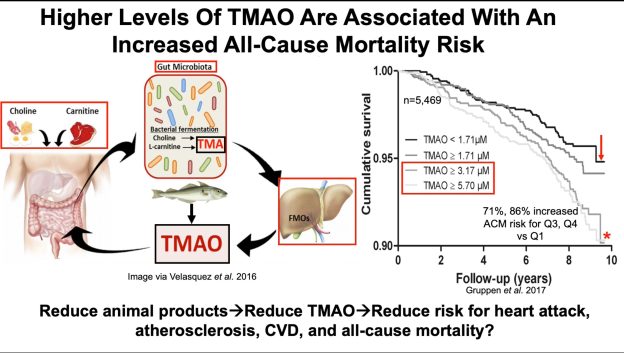
Kidney Function: The Missing Link In The TMAO-Health And Disease Story?

Animal products, including meat, cheese, and eggs contain carnitine and choline, metabolites that are converted by gut bacteria into TMA, which is then converted by the liver into TMAO. Plasma levels of TMAO are associated with an increased risk of disease and death, so should we limit intake of these animal products? Separately, fish contains relatively high levels of TMAO, and blood levels of TMAO spike after fish consumption, but there is a decreased all-cause mortality risk for fish consumers. To explain these disparate findings, other factors may be involved in the TMAO-health and disease story. In the video, I discuss the impact of kidney function on plasma levels of TMAO, disease and mortality risk.

Longevity Genes: APOE

A reduced mortality risk and an increased lifespan has been reported for people who have APOE2 alleles, when compared with APOE3 or APOE4, but beyond associations, data for lifespan in APOE-expressing mice was recently reported, evidence that supports a causative role for APOE on longevity.